waveorder#
waveorder is a collection of computational imaging methods. It currently provides QLIPP (quantitative label-free imaging with phase and polarization), phase from defocus, and fluorescence deconvolution.
These are the kinds of data you can acquire with waveorder and QLIPP:
What do I need to use waveorder#
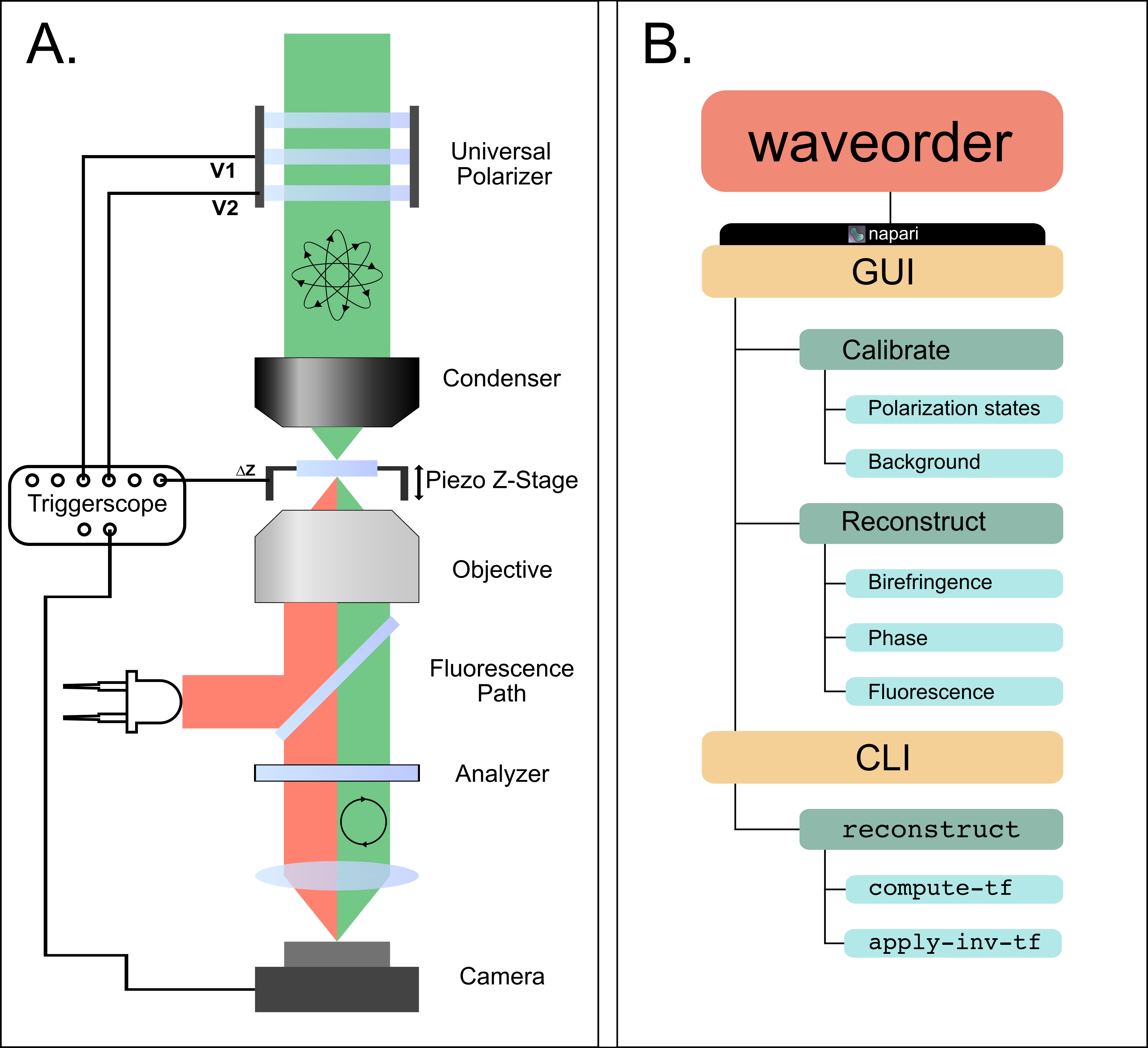
waveorder is to be used alongside a conventional widefield microscope. For QLIPP, the microscope must be fitted with an analyzer and a universal polarizer:
For phase-from-defocus or fluorescence deconvolution methods, the universal polarizer is optional.
The overall structure of waveorder is shown in Panel B, highlighting the structure of the graphical user interface (GUI) through a napari plugin and the command-line interface (CLI) that allows users to perform reconstructions.
Software Quick Start#
(Optional but recommended) install anaconda and create a virtual environment:
conda create -y -n waveorder python=3.12
conda activate waveorder
Install waveorder with acquisition dependencies
(napari with PyQt6 and pycro-manager):
pip install waveorder[all]
Install waveorder without napari, QtBindings (PyQt/PySide) and pycro-manager dependencies:
pip install waveorder
Open napari with waveorder:
napari -w waveorder
For more help, see waveorder’s documentation. To install waveorder
on a microscope, see the microscope installation guide.
Dataset#
Slides and a dataset shared during a workshop on QLIPP can be found on Zenodo, and the napari plugin’s sample contributions (File > Open Sample > waveorder in napari).

